Friday, 25 September 2015

Understanding Audience Research

In today's lesson we looked at effective audience research which will allow us to identify our target research. The two types of audience research can be quantitative (numerical data) or qualitative (opinions, ideas, etc). These can be carried out by either creating a questionnaire or a focus group.

Questionnaire
There must be a clear purpose behind each question in order to:

  • Determine what's popular
  • Determine what pupils like about the genre that appeals to them
  • Determine what values they believe are important in the genre
A questionnaire should include a maximum of eight questions with a mix of multiple choice, closed answers and also opportunities to leave a comment.

A questionnaire would allow our group to get opinions from others regarding our ideas. In addition, it would allow us to see if people enjoy or dislike our chosen genre. Finally, it would give us important information on changes we could make, taking into consideration peoples answers.

Focus Group
A focus group is more useful for collecting qualitative data compared to quantitative data.
    • A focus group is a small group of six to ten people, who are talked through the groups ideas by a moderator (a member of the group). Within the focus group there should be free flowing discussions regarding the idea.
    • The moderators role is to educate the small group of our ideas, in order for them to give feedback and create a discussion. This allows for various opinions of what people like and dislike so that we can make the appropriate changes.
    • A focus group usually contains a small number of predetermined questions, so that they cover all aspects of their idea.
    • A focus group should consist of a homogeneous group of strangers so that people will give their true reflection instead of copying what their friends might say.
When taking part in a focus group, questions should be:
  • Short and to the point
  • Focussed on one dimension
  • Open-ended
  • Non-threatening or embarrassing
You should use three types of focus group questions:
  1. Engagement questions
  2. Exploration questions
  3. Exit questions

British Genre Conventions

As we have chosen to focus our task on the film trailer, we decided as a group that the genre we would focus on would be British Drama. So that I can gain some knowledge of this particular genre, I am going to look at the typical conventions which make a British drama. An example of a British Drama would be 'This is England' or 'Football Factory'.


  • Firstly, drama films can into consideration real life situations and use realistic characters, settings and story lines.
  • The purpose of a drama film is to get the audience to feel emotionally engaged by the story being told. 
  • Throughout the film you will see how a character changes or develops as a person during a certain time period within the film.
  • There is also a lot of intense social interaction between the characters.
  • In addition, the audience can relate to what they are watching as the stories often include conflicts of real life hardships or difficulty which many people face during their life time.
  • There is often climaxes and anti climaxes so that the audience remain emotionally attached to the story.
  • Finally, drama films often end happily.
However, the Titanic breaks the typical conventions of a drama film as the ending is very tragic and does not end well for the protagonists. Also, 'A Serious Man' breaks the conventions as the audience know how the film is going to end.


Tuesday, 22 September 2015

Chosen Task and S.W.O.T analysis

As a group we have decided we are going to the following brief- A promotion package for a new film, to include a trailer, together with two of the following; a film magazine front cover and a poster for the film.

I think this brief suited us as a group as we gained valuable experience last year when we had to produce a title sequence to an opening film. From this I learnt different camera and editing techniques which I think will be useful for us when producing a film trailer. I am also looking forward to creating both a film magazine and a poster as last year we didn't do any print work, so this should be challenging but interesting at the same time. This year we are completing the film trailer as a group, in which I will be working with Sam Warren and Chris George, however, we will be completing the ancillary tasks as individuals. This year we will be able to learn from the mistakes we faced last year in terms of editing and filming schedules in order to create a more professional looking piece of work. I think a plan for filming and editing will be made and stuck to so that we don't encounter and problems that could affect our final piece.

In addition, I think the film trailer brief is most relatable to the group and myself in comparison to the music video or a soap opera, as we all enjoy watching films. However, in order to make sure the brief chosen was best suited for me, I decided to do a S.W.O.T analysis of four possible briefs. The S.W.O.T analysis was a very useful task in which I weighed up the pros and cons of each brief and came to the conclusion of the film trailer brief. Here are some images of my analysis that I constructed in lesson.


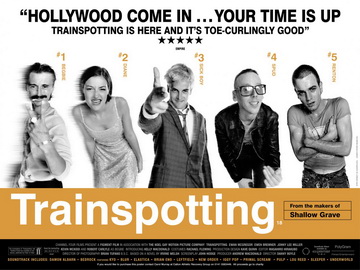
To further my research, I am going to have a look at a couple of film trailers relating to the genre of film we have decided to do, British Drama. I am going to look at trailers and film posters for films that relate to the genre, for example, Trainspotting, produced by Andrew Macdonald in 1996.